Interfaces Expand NI-XNET To Include LIN Support
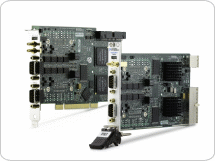
National Instruments (NI) has launched PXI and PCI interfaces for applications such as hardware-in-the-loop simulation, rapid control prototyping, bus monitoring and automation control. The new interfaces expand the NI-XNET platform to include support for the Local Interconnect Network (LIN) communication bus. The new NI PXI-8516 and NI PCI-8516 LIN interfaces make it possible for engineers and scientists to develop LIN applications in NI Labview, NI Labwindows/CVI and C/C++ for Windows and Labview Real-Time operating systems (OSs).
As part of the NI-XNET platform, the new PXI and PCI interfaces are said to be ideal for applications that require the real-time, high-speed manipulation of many LIN frames and signals. In addition, the new interfaces provide integrated support for importing and using signals from LDF databases, which simplify the scheduling and scaling of LIN messages on the bus. The NI-XNET range comprises PXI- and PCI-based products designed to communicate with embedded networks, including Controller Area Network (CAN), LIN and Flexray.
NI-XNET integrates with Labview, uses the same API for CAN, LIN and Flexray and automatically translates low-level frame data into usable engineering data. The new interfaces combine the performance and flexibility of low-level microcontroller interfaces with the speed and power of Windows and Labview Real-Time OS development. They can also be integrated into desktop real-time PCs as well as real-time PXI systems. Designed for demanding applications, the PXI and PCI interfaces are suitable for high-signal-count, low-latency environments.
The interfaces feature the NI-XNET device-driven DMA engine for coupling the LIN bus to the host memory, which reduces system latency from milliseconds to microseconds. The engine makes it possible for the onboard processor to move LIN frames and signals between the interface and the user program without CPU interrupts, freeing host processor time for processing complex models and applications.
As part of the NI-XNET platform, the new PXI and PCI interfaces are said to be ideal for applications that require the real-time, high-speed manipulation of many LIN frames and signals. In addition, the new interfaces provide integrated support for importing and using signals from LDF databases, which simplify the scheduling and scaling of LIN messages on the bus. The NI-XNET range comprises PXI- and PCI-based products designed to communicate with embedded networks, including Controller Area Network (CAN), LIN and Flexray.
NI-XNET integrates with Labview, uses the same API for CAN, LIN and Flexray and automatically translates low-level frame data into usable engineering data. The new interfaces combine the performance and flexibility of low-level microcontroller interfaces with the speed and power of Windows and Labview Real-Time OS development. They can also be integrated into desktop real-time PCs as well as real-time PXI systems. Designed for demanding applications, the PXI and PCI interfaces are suitable for high-signal-count, low-latency environments.
The interfaces feature the NI-XNET device-driven DMA engine for coupling the LIN bus to the host memory, which reduces system latency from milliseconds to microseconds. The engine makes it possible for the onboard processor to move LIN frames and signals between the interface and the user program without CPU interrupts, freeing host processor time for processing complex models and applications.
Comments